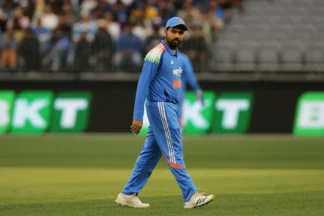
In the last two editions of the Women’s T20 World Cup, the India women’s cricket team has failed to qualify for the semifinals. The majority of the squad remained the same, and so did the results. What went wrong? Well, quite a bit. Some of it was unfortunate.
Marred by injuries
Pooja Vastrakar, Amanjot Kaur and Kashvee Gautam were ruled out of the tournament before it even started. Shreyanka Patil went down during it, and even Yastika Bhatia didn’t look at her best throughout the event. India lost 4 bowlers, three of whom were all-rounders, and in the end, that was probably the difference-maker.
But one can’t just cry over injuries. Several teams suffered setbacks and managed to overcome them. India needed to step up, and when it mattered most against the Australian and South African women‘s teams, they didn’t. One of the biggest letdowns was fielding again.
Shoddy fielding
In their last game against Australia, the Women in Blue didn’t drop a catch. On paper, that’s commendable. But India created just 4 chances in total. It’s the Proteas match that was lost due to shoddy fielding. 3 catches were dropped. Marizanne Kapp, the eventual ‘player of the match’, was dropped twice.
The veteran all-rounder was given two lives on 25 and 65. She went on to score 81. The fielder who dropped Kapp was India’s best, Radha Yadav. She didn’t play in that game but was subbed on. Her fingers were heavily taped, indicating she wasn’t 100%, but India brought her on and she dropped 2 catches.
In total, India dropped 10 catches in 5 matches. Only New Zealand and England dropped more, 12. If you notice, one of them still made the semifinal. That’s because catches don’t always win matches. It’s fine if you drop a catch or two, as long as you keep creating those chances. India couldn’t.
Paper-thin bowling
India’s bowling was paper-thin. In all 5 games, India changed the bowling attack. Against Australia, Kranti Gaud bowled just 1 over. They kept on picking frontline pacers and refused to back them. Arundhati Reddy was the starter but was persisted with for just 2 matches. Nandani Sharma didn’t bowl out in any of her 3 games.
India conceded 7.43 runs per over during the league stage. The four teams that qualified for the semifinals were all better on this front: Australia (6.21), South Africa (6.93), England (7.23) and West Indies (7.36). India’s head coach Amol Muzumdar identified the issues as well.
“I think if I have to pinpoint certain things in the entire tournament, I think we really need to think about our bowling and our fielding. If you look at our bowling attack, it’s been very inexperienced as far as international cricket is concerned,” Muzumdar said after losing to Australia.
Tactical blunders, aka Yastika Bhatia
However, the biggest issue was tactics. At the centre of which was Yastika Bhatia. The southpaw looked gingerly in the field. She didn’t run fast, and her weak arm was targeted by the opposition batters. But the biggest issue was her position. She batted at number 5 against the Netherlands and at number 3 against South Africa and Bangladesh.
However, in the biggest game, the knockout against Australia, Yastika didn’t bat. Deepti Sharma was sent ahead of her as India lost just 4 wickets. The management knew she struggles to rotate the strike, generate power, or run fast in the middle overs. Yet kept picking her over Bharti Fulmali.
Now, one can’t guarantee that India would’ve qualified had Bharti played, but her inclusion would’ve given the balance required. If the openers worked, the management tried to hide Yastika in the batting department. That’s why she ended with 41 runs in 3 innings with a strike rate of 117.14.
The management gave Bharti just one game, the Pakistan one, and moved on from her. But kept backing Yastika, who’s primarily a powerplay batter, to play in the middle overs. It isn’t her fault. She’s the backup keeper and opener. The management kept forcing her in when Jemimah Rodrigues could’ve batted there, and either Richa Ghosh or Bharti could’ve played the finisher’s role.
The reason’s apparent. Fear. India wasn’t looking for victory but fearing defeat. They kept deferring risk. Instead of bowling out Sree Charani against Australia, Harmanpreet Kaur held her back. Why? To get a couple of overs in from Shafali Varma and Radha. But you don’t beat Australia, who bat till 9, by sneaking junk overs. It wasn’t a one-off, but the entire campaign was riddled with similar errors, and the end result is justified.
 Cricket
India squad for Sri Lanka Tests to be picked this week: Bumrah, Jadeja to return, Washington Sundar doubtful
Cricket
India squad for Sri Lanka Tests to be picked this week: Bumrah, Jadeja to return, Washington Sundar doubtful