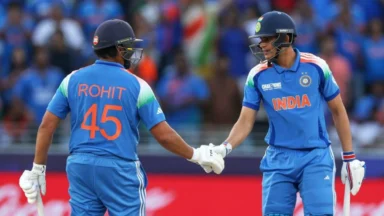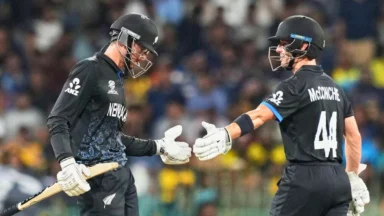
With the ICC Men’s T20 World Cup returning with its tenth edition, the tournament has given cricket fans some electrifying moments. Over these years, fans have seen drama, fights, and controversies in the T20 World Cup, but nothing matches the Super Over drama. Introduced to get a result of a tied match in limited-overs cricket, Super Overs have turned intense games into unforgettable memories.
With the tournament being witness to several such nail-biting finishes, in this article, we have revisited six such instances of Super Overs in T20 World Cup history that defined the event, created match-winners, and offered some unmatched excitement. Let’s look at the matches where even 40 overs seemed less to separate the two sides, and the Super Over became the ultimate decider.
All instances of Super Overs in T20 World Cup
- India vs Pakistan, T20 World Cup 2007
The first tied match in T20 World Cup history happened in its inaugural edition in 2007. With the tournament being played in Durban that year, the two teams reached 141 runs in a closely fought contest. Pakistan needed 17 runs in the final two overs. S Sreesanth bowled the 19th over and gave 8 runs, and Joginder Sharma, who came out to bowl the final over, also maintained his composure. On the final delivery, with the scores levelled, Misbah-ul-Haq was run out.
Although a Super Over did not exist at that time, the match was decided by a bowl-out. In this, each team chose five bowlers who attempted to strike the stumps. India bowled three successful stumps, whereas they failed to hit the stumps on all their attempts, thus resulting in India’s victory in a bowl-out.
- New Zealand vs Sri Lanka, T20 World Cup 2012
The first-ever Super Over took place in the 2012 T20 World Cup. In a match being played between New Zealand and Sri Lanka in Pallekele, both teams reached 174 runs. While New Zealand required 20 runs in the final two overs, Lasith Malinga bowled tight, and the scores were levelled.
Sri Lanka scored 13 runs in the Super Over. In reply, the Kiwis faced Malinga, who restricted them to 7 runs only, and as a result, Sri Lanka won the first-ever Super Over of the T20 World Cup.
- New Zealand vs West Indies, T20 World Cup 2012
Another Super Over instance took place in 2012 when New Zealand faced the West Indies. New Zealand chased 140 runs but finished at 139 at the loss of seven wickets, but before they could take the game, West took control as sixes from Chris Gayle and Marlon Samuels helped them chase the target in five balls.
- Namibia vs Oman, T20 World Cup 2024
In a match between Namibia and Oman at the T20 World Cup 2024, while chasing a low score of 109, Namibia needed 16 runs in the last two overs. Aamer Jamal gave away only 5 runs in the 19th over, but Ruben Trumpelmann scored a boundary to tie the match. Thereafter, they scored 21 runs in the Super Over, with David Wise hitting a four and a six. In reply, Oman were seen struggling to get to 21 runs as David Wiese bowled well and gave only 10 runs to help his side emerge victorious.
- USA vs Pakistan, T20 World Cup 2024
The USA, which played its first T20 World Cup in 2024 in a match against Pakistan, saw them take the match in the Super Over. The USA scored 18 runs in the Super Over, whereas Saurabh Netravalkar defended the score as he gave only 13 runs. As a result, the USA achieved an unexpected victory in the group stage match.
- South Africa vs Afghanistan, T20 World Cup 2026
In the ongoing T20 World Cup 2026, underway in India and Sri Lanka, the group stage match between South Africa and Afghanistan saw a double Super Over to decide the winner. The match, which was played at the Narendra Modi Stadium in Ahmedabad, South Africa, was posted 187/6. In reply, Afghanistan also chased the target while losing all their players in 19.4 overs.
In the Super Over, Afghanistan batted first and scored 17 runs. The Protea Men also scored 17 runs, losing one wicket, taking the game into another Super Over. David Miller and Tristan Stubbs went berserk in the second Super Over as they combined to score 23 runs. This chase didn’t seem easy for the Afghans, as they lost by four runs.
 Cricket
India squad for Sri Lanka Tests to be picked this week: Bumrah, Jadeja to return, Washington Sundar doubtful
Cricket
India squad for Sri Lanka Tests to be picked this week: Bumrah, Jadeja to return, Washington Sundar doubtful