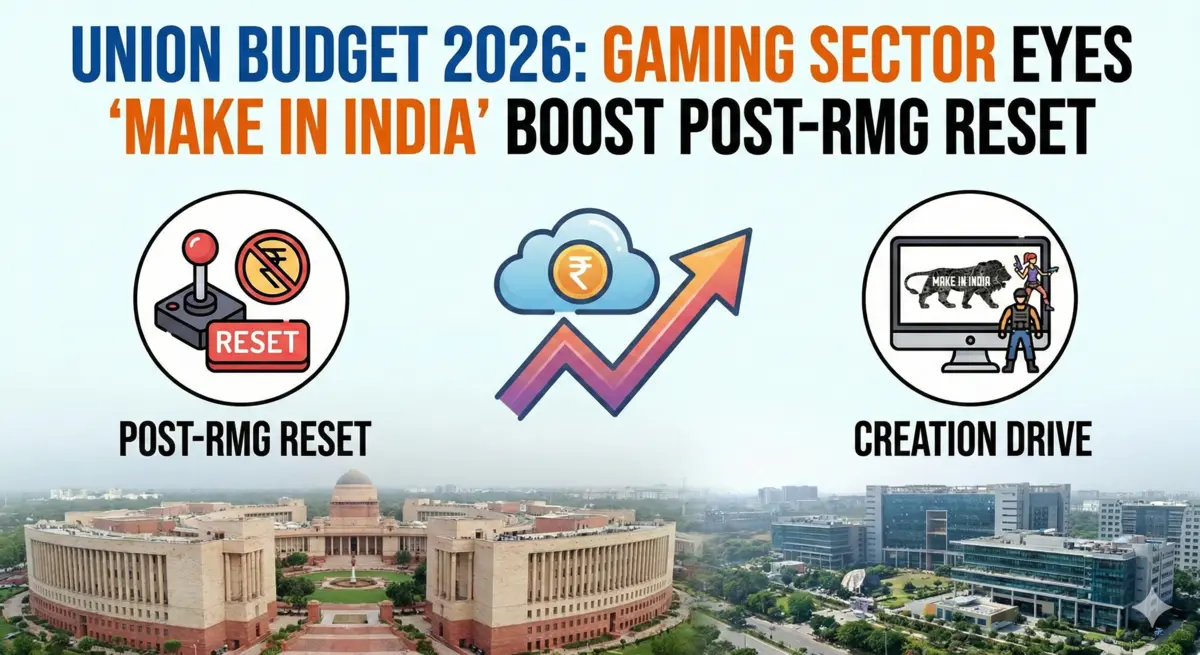
If 2025 was the year of the “Great Reset” with the ban on Real-Money Gaming (RMG), 2026 promises to be the year of the “Great Build.” As we approach the Union Budget, the Indian gaming industry stands at a critical inflection point. The conversation has moved beyond what is banned, to what can be built. Check out the Union Budget 2026 expectations below.
There is renewed optimism that the Finance Ministry will recognize this shift. With the government already signaling support for the video gaming ecosystem, the industry hopes for a budget that fuels a transition from a consumption-heavy market to a creation-driven economy.
Why Union Budget 2026 matters:
- A Global Contender: Video gaming in India is growing faster than almost any other digital entertainment vertical in Asia.
- The $8 Billion Opportunity: The BITKRAFT India Opportunity Report 2025 projects the sector will triple to ~$8 billion by FY 2030.
- The Talent Pivot: The goal is to transform India’s massive user base (500M+ gamers) into a powerhouse of developers, artists, and storytellers.
For the first time, the industry is asking for a framework that supports studios and IP creation, ensuring that the next global gaming hit is not just played in India, but made in India.
Also Read:
- Free Fire MAX Redeem Codes Today March 10 Indian Server Bring Free Rewards
- Free Fire MAX OB53 Advance Server: Expected Release Date And Registration Guide
- FFMIC 2026 Knockout Stage: Teams, Schedule, Format, and More
- Free Fire OB53 Update Release Timeline, Collaboration, and More
- Free Fire MAX Booyah Pass April 2026: Release, Leaked Rewards, and More
Sridhar Muppidi, Chairperson, GDAI (Game Developer Association of India), states, “As India accelerates toward its goal of a $1 Trillion digital economy, the gaming sector stands at a pivotal inflection point. Our recommendations for Budget 2026 focus on a ‘surgically targeted’ approach: rather than asking for new greenfield projects, we are advocating for dedicated ‘Gaming Carve-outs’ within existing flagship schemes like Startup India (SISFS) and Skill India (PMKVY). By earmarking funds for prototype development and specialized ‘Creative Tech’ apprenticeships, the government can provide the high-octane fuel needed for Indian studios to build world-class Intellectual Property. Our vision is to transform India from being the world’s largest consumer of games into its most prolific creator, ensuring that ‘Made in India’ games are played on every console and smartphone globally.”
Nitish Mittersain, Jt. MD & CEO, Nazara Technologies, adds, “We are optimistic about the government’s continued focus on strengthening India’s digital and creative economy. For the gaming and interactive entertainment sector, a stable and predictable policy framework will be key to driving long-term growth and investor confidence. Support for domestic game development, encouragement of original IP creation, investments in skilling and digital infrastructure, and focused initiatives around esports and animation can significantly accelerate the industry’s momentum. India also has a unique opportunity to leverage its rich cultural heritage, mythology, and storytelling traditions to create globally successful gaming IPs. With the right ecosystem support, India can emerge as a global creative powerhouse in interactive entertainment. We look forward to a progressive, growth-oriented Union Budget 2026 that enables innovation while promoting responsible industry development.”
Anuj Tandon, Partner – India & UAE, BITKRAFT Ventures, says, “India’s gaming industry is at a defining inflection point, driven by a massive digital-first audience and global demand for content – especially since clarity on regulation by the government. Union Budget 2026 should recognize gaming as a core pillar of the AVGC-XR ecosystem, not just a consumer industry. My wish list would include tax incentives for global video gaming companies setting up shop in India that will help upgrade our talent pool to be industry ready to build games from India to the world. With the right policy push, India can emerge as a global hub for game development and interactive entertainment exporting our culture effectively.”
Anurag Choudhary, Founder & CEO, Felicity, says, “India’s gaming opportunity should increasingly be viewed through the lens of production, not just consumption. While the domestic market continues to grow, the larger long-term opportunity lies in building globally competitive games, original IP, and scalable publishing platforms that can reach international audiences. With clearer regulatory frameworks in place, the ecosystem can shift its focus toward strengthening fundamentals like product quality, retention, and sustainable monetisation, rather than short-term market cycles. India has strong engineering, creative, and analytical talent, and when paired with the right infrastructure and publishing systems, it has the potential to emerge as a meaningful global producer of gaming content, not just a large consumer market.”
Akshat Rathee, Co-founder and MD of NODWIN Gaming, I’m hopeful that this year’s Union Budget 2026 acknowledges gaming and esports as emerging pillars of India’s digital and creative economy. Over the last few years, the sector has moved from the fringes to the mainstream, and what it now needs is execution-focused policy support. This includes fair and differentiated taxation for esports on par with traditional sports, easier access to banking and financial services for gaming businesses, and targeted funding under the AVGC framework to support Indian game development and original IP creation. With the right incentives for exports, infrastructure, and state-level esports events, India has a real opportunity to strengthen its global soft power through gaming. The focus doesn’t need to be on large announcements, but on practical enablers that help the ecosystem scale sustainably.
Animesh Agarwal, Co-founder and CEO, S8UL Esports, With the Promotion and Regulation of Online Gaming Act now in place, the conversation around gaming and esports has shifted from legitimacy to capacity building. This Budget presents a timely opportunity for policymakers to commit fiscal support towards training, infrastructure, grassroots competition development, and strengthening India’s global position in esports. Beyond gaming-specific measures, sectors such as sports, education and skill development, digital infrastructure, startups, and the creator economy will play an important role in shaping the ecosystem. Investments in training infrastructure, incubation programs, and R&D hubs can strengthen game development and creative production, while support for creator-focused upskilling, production facilities, and IP development can help build sustainable careers. Greater clarity and budget allocation at the central level, along with a dedicated funding focus for gaming within the AVGC framework, can further enable the creation of globally scalable Indian IPs.
Mr Sagar Nair, Head of Incubation, LVL Zero Incubator, As India’s gaming and esports ecosystem matures, this Union Budget 2026 presents an opportunity to shift the conversation from consumption to creation. The industry today needs regulatory and taxation clarity across mobile, PC, and console gaming to unlock long-term capital, enable predictable business planning, and attract global publishing partnerships. Clear budgetary commitment toward the AVGC-XR mission, with a focus on original IP creation, advanced skilling, and studio incubation, can meaningfully accelerate India’s position as a global game development hub. Incentives that support local game development, improve access to gaming hardware, and encourage export-led growth will help Indian studios move up the value chain and build globally competitive products. Esports, too, stands to benefit from formal policy recognition and ecosystem-level investment that strengthens domestic talent pathways and international participation. Taken together, these measures can help India move beyond scale alone and build a sustainable, creator-led gaming economy with global relevance.
Vishal Parekh, Chief Operating Officer, CyberPowerPC India, Indian gaming and esports are at a defining moment. PROGA 2025 marked the start of a more structured and legitimised chapter for the industry, recognising its growing cultural and economic relevance. As the ecosystem scales, targeted budget support and clear policies will be key to sustaining this momentum.
Treating esports prize money taxation in line with traditional sports, strengthening esports’ role within Khelo India, and encouraging participation across schools, colleges, and states can significantly boost grassroots development. We are hopeful the upcoming budget will support these priorities and help India build a globally competitive gaming and esports ecosystem.