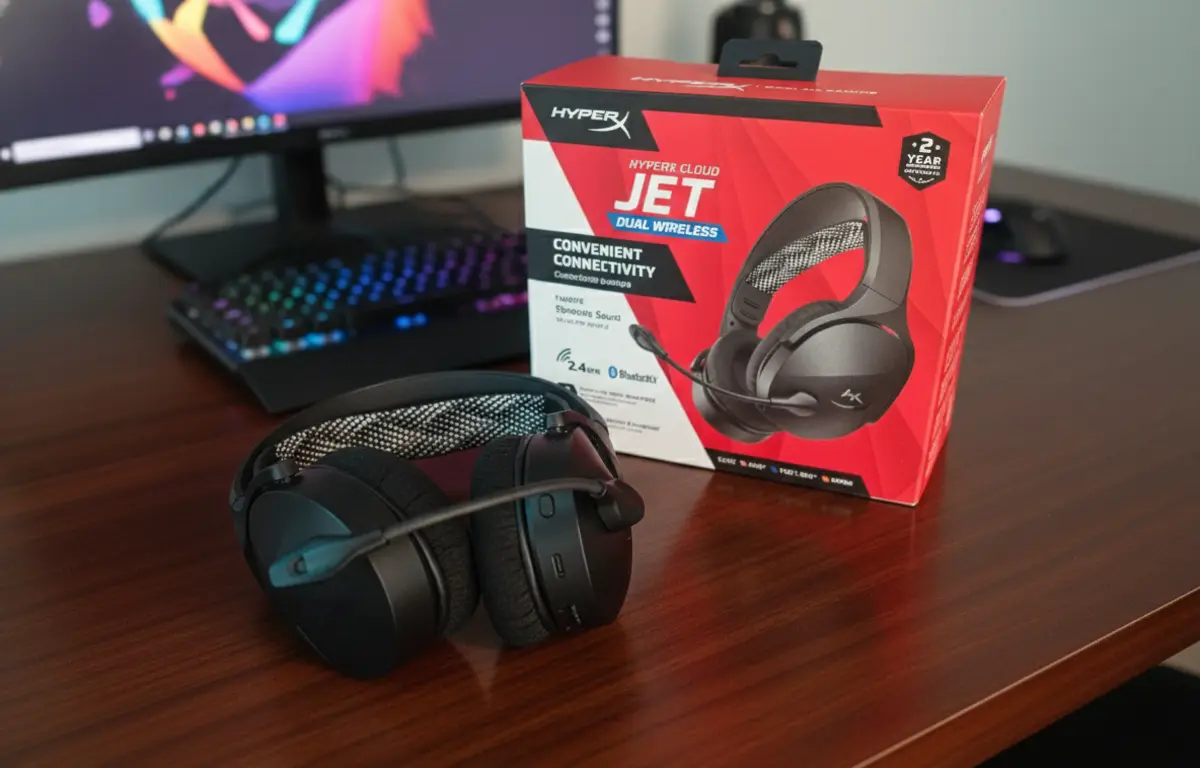
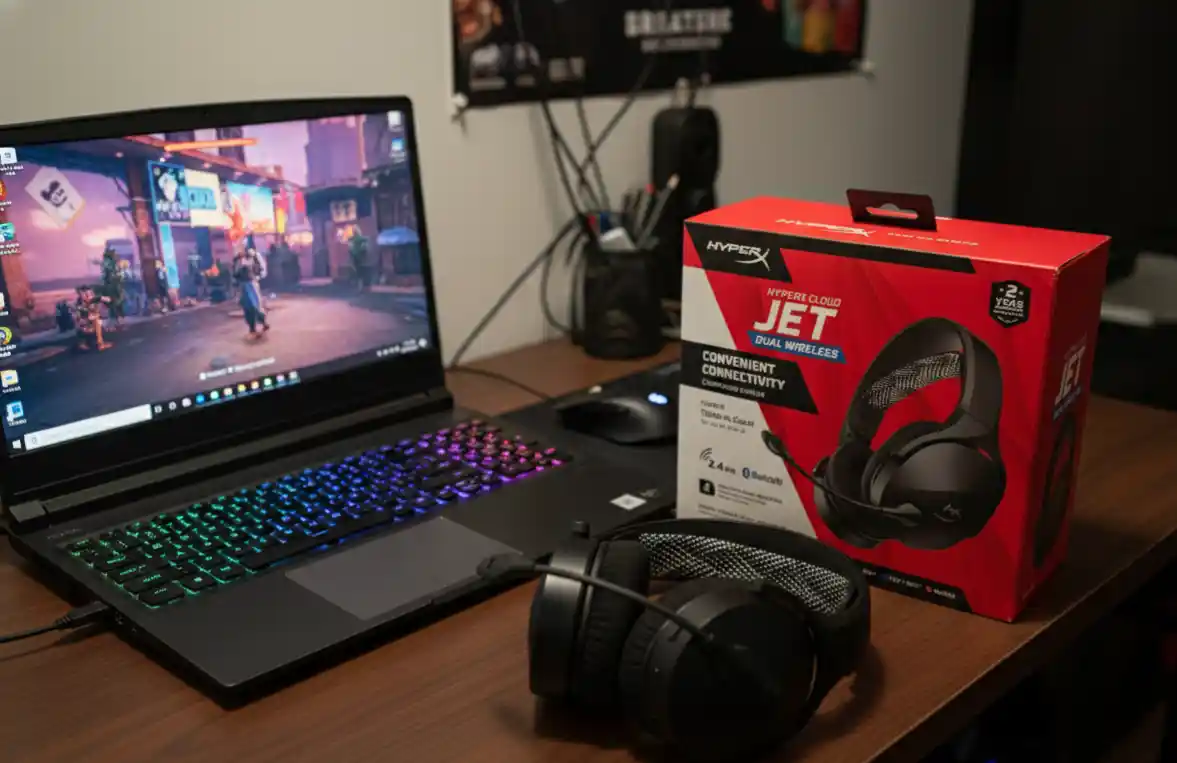
The wireless gaming headset market has never been more crowded. Every brand promises “zero latency,” “cinematic surround sound,” and “esports precision.” RGB lighting pulses. Bass gets exaggerated. Software becomes bloated with features most gamers never use. Recently, I tested the HyperX Cloud Jet Wireless Gaming Headset (Black) across PC, PS5, and mobile, running:
- Competitive FPS sessions (BGMI, Free Fire, CS2-style audio tests)
- Cinematic titles (story-driven gaming sessions)
- Music sessions (EDM, rock, acoustic, orchestral)
- Discord and in-game voice chat
- Bluetooth mobile usage
- And side-by-side comparisons with a wired reference headset
This is the full-spectrum, no-compromise review.
1. SOUND PERFORMANCE – The Core of Any Gaming Headset
A gaming headset lives or dies by its audio accuracy and this is where you’ll immediately know if it’s worth your money.
A. Positional Accuracy (Imaging & Soundstage)
To evaluate positioning, I ran competitive FPS matches, directional sweep test tracks, wired vs wireless comparisons, and latency checks between 2.4GHz and Bluetooth modes.
If you play ranked matches, this section matters most.
- In BGMI, footsteps inside buildings are easy to distinguish from outdoor movement. The mids are slightly forward, which helps isolate enemy movement from environmental noise. You don’t have to strain to identify positioning. Footsteps don’t get buried under ambient sound.
- In VALORANT, gunfire positioning feels controlled and clear. Left/right separation is precise. Front/back cues are reliable enough that you can react confidently without constantly second-guessing direction. That matters in close combat situations where hesitation costs rounds.
Does it provide a competitive advantage? In mobile FPS titles, yes. The clarity-focused tuning works in your favor. It doesn’t artificially widen the stage, but it presents information cleanly.
Soundstage width is moderate. It’s not expensive like open-back headphones. It’s also not claustrophobic. It sits in that middle zone where everything feels focused rather than dramatic. If you expect cinematic spread, it may feel contained. If you prioritize tight positional cues, it makes sense.
I have rated Imaging Accuracy for easier representation below:
- Left/right separation: ⭐⭐⭐⭐⭐
- Front/back layering: ⭐⭐⭐⭐☆
- Vertical cues: ⭐⭐⭐☆☆
As you can see, Left/right imaging is excellent. Front/back layering is strong. Vertical cues are decent but not top-tier. Without built-in Dolby or proprietary spatial processing, vertical separation relies heavily on the game engine.
PS5 Tempest 3D Audio Test
On PS5, using Tempest 3D Audio, vertical positioning improves noticeably. The stage expands slightly, and directional layering becomes more dimensional. Still, it doesn’t reach the immersion level of premium spatial-focused headsets. Overall positional performance is strong for competitive use.
Final Positional Score: 8 / 10
B. Sound Signature Analysis
This headset is tuned for competitive clarity, not dramatic cinematic impact.
Bass
The bass is tight and controlled rather than overpowering. It avoids muddiness and never masks footsteps or reload sounds. However, if you love deep sub-bass rumble for EDM drops or cinematic explosions, you may find it slightly restrained.
Mids
This is where the Cloud Jet truly shines.
- Vocal reproduction is clear and natural.
- Footsteps and reload sounds sit forward in the mix.
- Dialogue in story games feels articulate and easy to follow.
You’ll immediately notice how easy it is to separate important sounds from background noise.
Cinematic Gaming Test
In story-driven games:
- Explosions lack deep cinematic punch.
- Dialogue remains excellent.
- Environmental ambience is present but not immersive-wide.
If you want theater-like immersion, this may feel restrained. But if you prioritize clarity, it performs well.
Music Performance by Genre
- EDM: Good punch, limited deep rumble.
- Rock: Excellent guitar and vocal clarity.
- Acoustic: Clean and natural.
- Orchestral: Moderate depth, limited staging width.
You can absolutely enjoy music on it — just don’t expect audiophile-level layering.
Sound Signature Score: 8 / 10
2. MICROPHONE QUALITY
Microphone quality is another area where practical performance matters more than marketing claims.
A. Voice Clarity
We have tested it via:
- Discord calls
- In-game squad chat
- Raw mic recording comparison vs USB condenser mic
Compared to a USB condenser microphone, the Cloud Jet’s mic delivers clear and understandable voice transmission. There is slight compression typical of wireless headsets, and the frequency capture is narrower than a standalone condenser mic, but teammates report clear, distortion-free communication.
Voice Clarity Score: 8.5 / 10
B. Noise Rejection
Noise rejection is solid, though not AI-enhanced. Mechanical keyboard typing is partially filtered; teammates can hear faint clicking but not at disruptive levels. A medium-speed room fan remains mostly suppressed, and your voice stays dominant in the mix. Background conversations are partially picked up if close to the mic, reflecting the limits of a standard unidirectional boom without advanced noise-canceling algorithms.
Noise Rejection Score: 7.5 / 10
C. Mic Features
- Swivel-to-mute boom mic ✅
- Built-in sidetone ✅
- No AI noise cancellation ❌
- No detachable mic ❌
- No broadcast mode ❌
Sidetone is subtle and natural, helping you avoid shouting during matches.
Mic Features Score: 7 / 10
3. WIRELESS PERFORMANCE
Wireless performance is solid where it matters. On 2.4GHz, latency is low enough that it feels instant during gameplay, which is in fact under 20ms. I didn’t notice sync issues or delays in competitive matches. Bluetooth is fine for casual use, music, or calls, but like most Bluetooth audio, it’s not something you’d rely on for serious competitive timing. The dual wireless system is convenient, though. Being able to jump between your PC and phone without unplugging cables is genuinely useful in daily use.
Latency Score: 9 / 10 (2.4GHz)
Range
| Distance | Result |
|---|---|
| Up to 5m | You can hear it perfectly |
| Up to 10m | Stable sound |
| Up to 12m + 1 wall | There will be minor interference |
| Up to 15m | Dropouts begin in sound |
Multi-Device Connectivity
- Easy switching between 2.4GHz & Bluetooth
- No simultaneous dual audio mixing
- Quick pairing process
Multi-device flexibility is strong.
Connectivity Score: 8.5 / 10
4. BATTERY & CHARGING
| Mode | Claimed | Tested |
|---|---|---|
| Bluetooth | 25 hrs | ~23 hrs |
| 2.4GHz | 20 hrs | ~18–19 hrs |
Battery life aligns closely with manufacturer claims. In Bluetooth mode, real-world usage reaches approximately twenty-three hours compared to the advertised twenty-five. In 2.4 GHz mode, it delivers around eighteen to nineteen hours instead of the claimed twenty. USB-C charging takes roughly four and a half hours for a full charge, and the headset can be used while charging.
The absence of RGB lighting contributes positively to battery efficiency.
Battery Score: 8 / 10
5. COMFORT
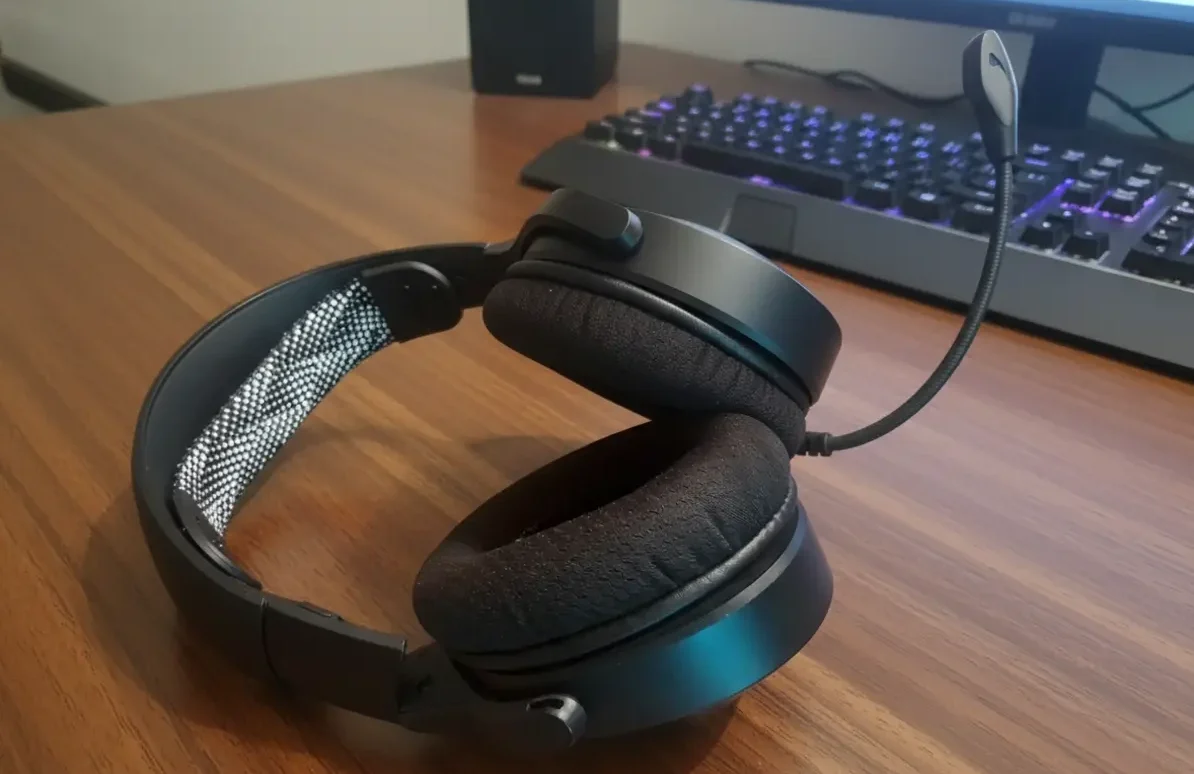
Comfort is one of the headset’s strongest attributes. At 298 grams, it is lightweight for a wireless model. During extended four- to six-hour sessions, there is no crown hotspot or excessive clamp pressure. Weight distribution feels even, and heat buildup is minimal thanks to breathable ear padding. For gamers who prioritize long-session comfort, this is a major advantage.
Comfort Score: 9 / 10
6. BUILD QUALITY & DURABILITY
Build quality combines magnesium alloy components with durable ABS plastic. The frame uses an elastic band system for adaptive fit. Light twisting produces no creaking, hinge tension feels firm, and physical buttons are tactile and responsive. The swivel microphone moves smoothly. One drawback is that ear pads are not easily replaceable, which may affect long-term maintenance.
Build Score: 7.5 / 10
7. PLATFORM COMPATIBILITY
| Platform | Performance |
|---|---|
| PC | Excellent |
| PS5 | Tempest works |
| PS4 | Stable |
| Mac | Functional |
| Mobile | Strong via Bluetooth |
| Xbox | Not officially licensed |
Xbox compatibility is also limited since it’s not officially licensed.
Compatibility Score: 8 / 10
8. CONTROLS & USABILITY
Controls and usability remain refreshingly straightforward. Physical buttons are easy to locate by touch. Volume adjustment is intuitive. Mode switching between wireless options is simple and reliable. There is no dedicated game/chat balance dial, and software customization is minimal, but the simplicity contributes to plug-and-play reliability. Aesthetically, the headset adopts a minimalist and mature design.
Usability Score: 9 / 10
9. RGB & AESTHETICS
There is no RGB lighting. For some users, this may seem less exciting, but it reinforces a professional look and preserves battery life.
- Aesthetic: Minimalist, mature.
10. NOISE ISOLATION & LEAKAGE
Noise isolation from the closed-back design is effective, reducing environmental distractions while minimizing audio leakage at moderate volumes, making it suitable for LAN environments or shared spaces.
11. VALUE FOR MONEY
From a value perspective, the Cloud Jet Wireless competes strongly in the mid-range wireless tier. Compared to budget wireless headsets, it offers better wireless stability, more refined tuning, and stronger build consistency. Compared to mid-range competitors, it maintains similar competitive clarity, though with a slightly narrower soundstage. Compared to premium-tier models, it lacks advanced spatial processing, expansive immersion, and deep software customization.
Value Score: 8.5 / 10
12. ADVANCED TECHNICAL METRICS (Based on Spec & Testing)
| Metric | Performance |
|---|---|
| Frequency Response | 20Hz–20kHz |
| THD | ≤ 2% |
| Sampling Rate | 48kHz |
| Bit Depth | 16-bit |
| Mic Sensitivity | -16 dB FS |
| Impedance | 32Ω |
| Wireless Range | 15m |
FINAL VERDICT
It’s clearly tuned and built for practical competitive gaming. After testing it across PC, PS5, and mobile, the conclusion is simple: it focuses on the fundamentals and mostly gets them right.
The strongest part of this headset is its imaging. Directional accuracy is reliable. Left and right separation is clear, and front-to-back positioning is consistent enough that you don’t feel confused during fights.
Wireless performance is another important win. In 2.4GHz mode, latency is low enough that it feels instant in actual gameplay. Gunshots, reloads, and movement cues line up with what you see on screen.
Comfort is also a big plus. At under 300 grams, it’s light for a wireless headset. During long sessions, there’s no major pressure hotspot on the head, and the clamp force feels balanced.
Heat buildup is controlled. If you play for hours at a time, this is something you’ll appreciate more than flashy features.
Now, where does it hold back?
The soundstage isn’t very wide. If you’re looking for cinematic immersion or theater-like depth in story games, it may feel a bit restrained. Bass is controlled rather than powerful. Explosions don’t rumble aggressively. There’s also no advanced software ecosystem, no deep EQ customization, and no RGB lighting. Some people won’t care. Others might miss those extras.
FINAL SCORE: 8.6 / 10
If you are:
- ✔ Competitive gamer
- ✔ Mobile FPS player
- ✔ Looking for lightweight wireless
- ✔ Want plug-and-play reliability
This headset deserves serious consideration.
If you want:
- ❌ Heavy bass immersion
- ❌ Studio-level microphone
- ❌ RGB spectacle
You may want to look higher up the price ladder.
 Cricket
Black clouds over IND vs PAK T20 World Cup clash, as Sri Lanka issues Colombo weather warning
Cricket
Black clouds over IND vs PAK T20 World Cup clash, as Sri Lanka issues Colombo weather warning