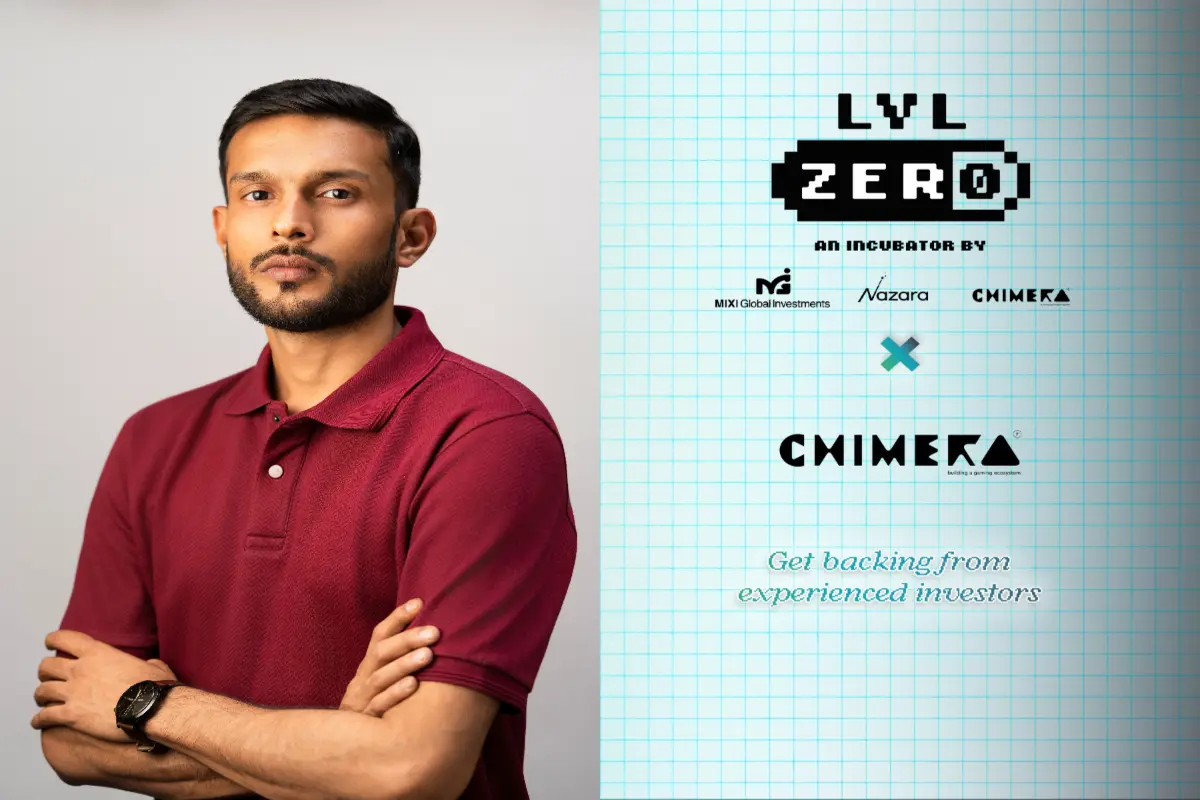
In a bid to transform India from a gaming “consumption hub” into a global “production powerhouse,” LVL Zero—an incubator born from the partnership between MIXI Global Investments, ChimeraVC, and Nazara Technologies—has launched a high-velocity, 100-day execution sprint.
Unlike traditional, theory-based curricula, this program provides 10 selected startups with an equity-free USD 10,000 grant and forces them to iterate in real-world market conditions. Leading this charge is Sagar Nair, Head of Incubation at LVL Zero and a gamer-turned-operator.
In this exclusive interview with Insidesport, Nair explains why speed is the only way to survive the Indian market, the “game tech” innovations that will disrupt the globe, and how his goal of nurturing 100 startups will fundamentally rewrite India’s creative reputation by 2030.
The Power of the 100-Day Market Test by LVL Zero
Why is a 100-day execution sprint more effective for Indian gaming startups than a traditional curriculum-based program?
In India, the constraint is not knowledge, it’s time, capital, and decision clarity. A 100-day execution sprint forces teams to operate in real market conditions, not simulated ones. Instead of learning frameworks in isolation, founders are required to ship, test, iterate, and make hard decisions with real users and real data. This compresses learning into a timeframe that matches the economic realities of Indian studios, where runway is limited and iteration cycles need to be fast, not theoretical.
Read More about BGMI
- BGMI Redeem Codes Today February 6 Offer Labyrinth Scale M24
- BGMI 4.3 Update Leaks Reveal Passive Skills Mode With Five Skills
- BGMI Lite Release Date 2026? Krafton Surveys Spark Launch Speculation
- BGMI 4.3 Update Release Date (Expected) and New Features Leaked
- Best Zero Recoil Sensitivity Codes for BGMI in 2026
What is the most common mistake founders make when moving from a prototype to a market-ready product?
The most common mistake is mistaking a playable build for a viable product. Founders often optimize for feature completeness or polish before validating retention, monetization, and iteration speed. As a result, critical decisions are made without enough signal. This leads to overbuilding in the wrong direction instead of learning quickly from real player behavior.
How does your background as a gamer and operator change how you evaluate a startup’s core product loops?
As a gamer, I evaluate whether the core loop is genuinely engaging or whether it creates intrinsic motivation to return. As an operator, I look at whether that loop is measurable, optimizable, and scalable. That combination shifts the focus from “Is this fun?” to “Is this fun and repeatable under real-world constraints like acquisition cost, session depth, and content cadence?”
India’s Role in Global ‘Game Tech’ Innovation
Beyond player numbers, what specific Indian ‘game tech’ or AI innovation do you believe will disrupt the global market next?
India is uniquely positioned to lead in low-cost, high-efficiency game infrastructure, especially AI-driven live operations, automated content generation, and player behavior modeling at scale. The real disruption won’t come from blockbuster visuals, but from systems that allow small teams to operate like large studios, delivering personalized experiences at fraction-of-global costs.
How will the success of LVL Zero’s 100-startup goal fundamentally change India’s reputation as a creative gaming hub by 2030?
If India produces 100 execution-ready gaming startups, the narrative shifts from “high-volume market” to “repeatable creator ecosystem.” Success won’t be defined by one breakout studio, but by a generation of teams that can ship, learn, and scale multiple times. That changes India’s global reputation from a consumption-heavy market to a durable production hub for game innovation.