When India and Pakistan take the field on September 28, it won’t be just a cricket match. The electric game in Dubai will be treated as a proxy war. For all those naive people who say, ‘Sports shouldn’t mix with politics,’ they don’t realise that they have always coexisted.
For a good portion of the 20th century, the Olympics were used as a way to show superiority. Russia and the USA treated the world’s biggest sporting event as an arena for fighting the battle they couldn’t in the battleground.
India vs Pakistan: it’s never been about just cricket
India and Pakistan have been doing the same for decades. There’s a reason why England vs Australia isn’t the biggest cricket match despite having superior quality of play and history on their side.
The quality of gamesmanship on the field doesn’t matter in an India vs Pakistan cricket match. It never has, and perhaps it never will. Which team has the better batter or bowler is irrelevant. There’s a reason why Venkatesh Prasad’s fight with Aamer Sohail is more famous than the famous six Sachin Tendulkar hit Shoaib Akhtar in 2003.
The public and governments from both nations have often leaned into the idea that India vs Pakistan isn’t just a match. It’s symbolic. It showcases which country is superior. Because history textbooks from both sides claim they won in wars (1947-48, 1965, 1971, and 1999).
Even the cricketers felt the heat. If they lost, stones were pelted at their houses, and effigies were burnt. They even got advice not to return home right now, as the public was angered. But, in the last decade or so, the cricketers had started treating the match as ‘just a cricket game’.
Cricketers get involved
It was great while it lasted. Because even the cricketers have got involved now. In the aftermath of the May skirmish, the nationalistic side of cricketers came out. The future of the Asia Cup itself seemed uncertain, but somehow it has gone ahead as planned.
But, as expected, India vs Pakistan courted controversy. It started with many in India asking to boycott the match. But then it escalated after Team India refused to shake hands after beating their neighbours in a one-sided match on September 14. This opened a can of worms.
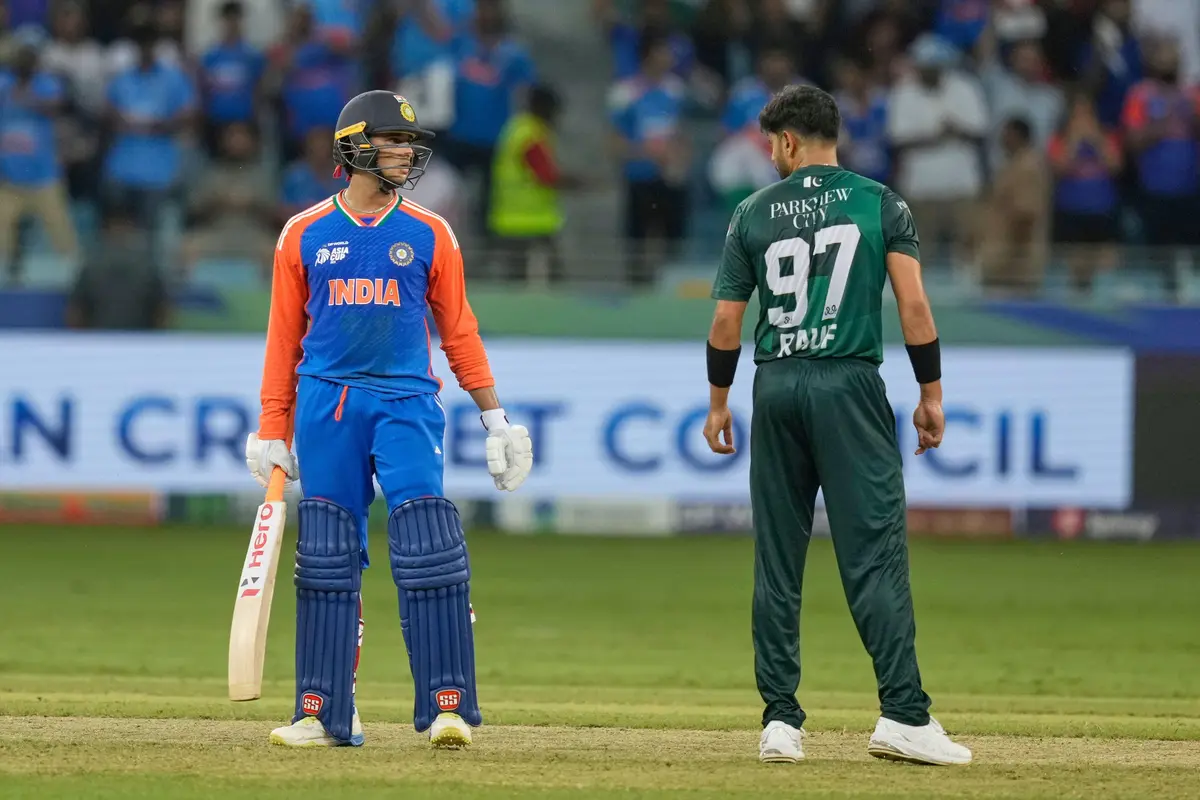
Pakistan displayed its anger at the ICC and official Andy Pycroft. But that was just the start. Things were mellow on September 21 until Sahibzada Farhan pulled out a ‘gun celebration’ to commemorate his half-century. Later, Haris Rauf and Shaheen Shah Afridi showed aggression, not in their bowling but in their follow-throughs with words of abuse.
Abhishek Sharma and Shubman Gill responded likewise. But Haris took things to a whole other level. Getting heckled by the Indian crowd on the boundary line, Haris enacted what happened in the skirmish. He made a hand aeroplane to show that Pakistan knocked down 6 Indian jets while India couldn’t do any damage to them.
As mentioned above, history often gets skewed in both nations. No side can admit defeat. While it’s been disproved that India failed to do any damage to Pakistan during their May skirmish, it’s something that the public in Pakistan largely believes. Haris happens to be one of them.
Losing, not an option
From this moment on, India vs Pakistan has never been a cricket match. It’s anything but. Politicians are actively involved now, not that they weren’t before. Mind you, the Pakistan Cricket Board (PCB) Chairman is the interior minister of Pakistan.
Both sides want blood now. They don’t want their players to be hunky-dory. No one wants smiles on the faces of the players. They expect them to hurl abuses at the other side. There’s no talk about lifting the Asia Cup trophy. No one cares that it’s the first time India and Pakistan are playing an Asia Cup Final.
This isn’t just a cricket match, and losing isn’t an option for either side.
 Cricket
Exclusive | Yograj Singh lashes out at Ashwin, vows to make Arjun Tendulkar world's greatest batter
Cricket
Exclusive | Yograj Singh lashes out at Ashwin, vows to make Arjun Tendulkar world's greatest batter


 Strongest KKR playing XI for IPL 2026: Batting order needs to be sorted, spin department threatening