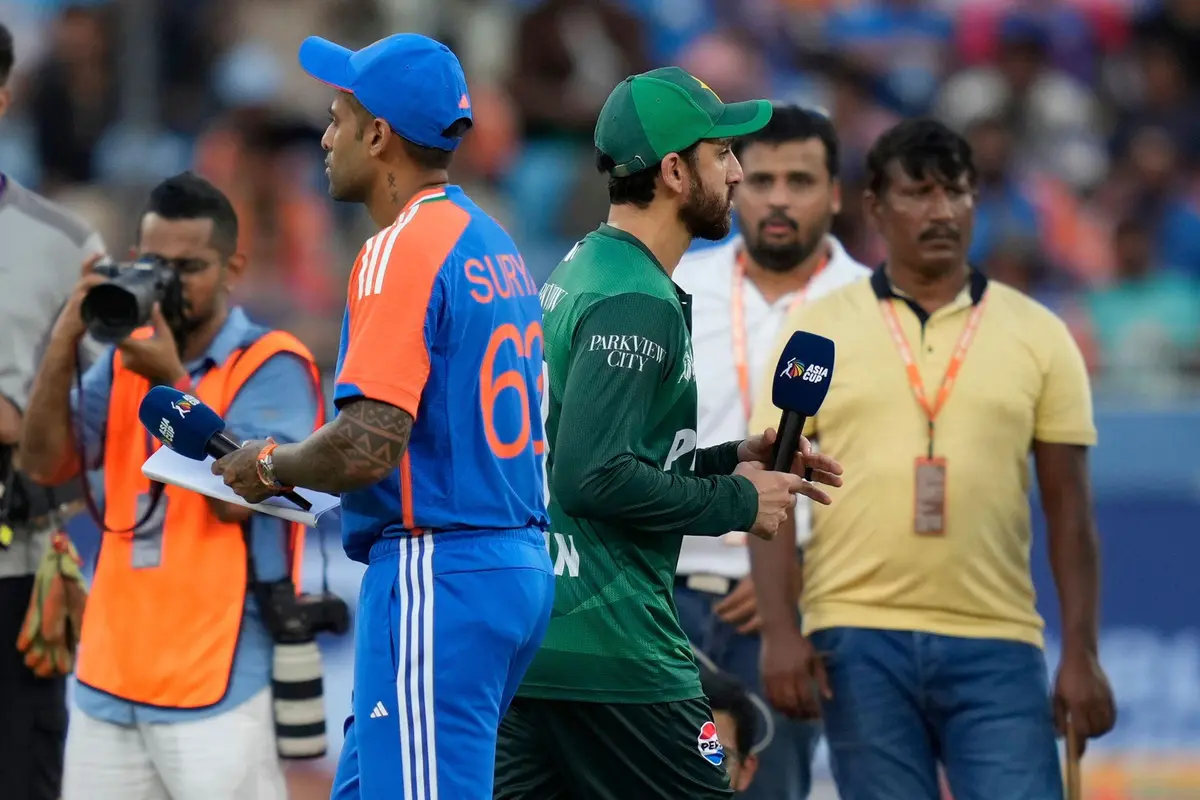
Every Asia Cup has become a tug of war between two nations: India and Pakistan, to the extent that one could foresee how it would play out. India and Pakistan disagree on almost everything and even the Asia Cup. This time, on the backdrop of the Pahalgam terrorist attack and Operation Sindoor, a cricket tournament never seemed likely. Even Indian players did not expect the tournament to happen. Yet, despite refusing to attend the ACC meeting in Dhaka, BCCI agreed to host the Asia Cup 2025, albeit in the UAE. But the unexpected tournament has its expected consequences. India’s refusal to ditch the tradition and shake hands with Pakistani players, the Indian captain Suryakumar Yadav making a political statement, and the latter trying to take the tournament hostage to have its ego satisfied. All are wrong!
Then, why is the Asia Cup 2025 happening? Nobody knows! Many believe the tournament is jinxed. But more often than not, it has fallen victim to the ego tussle between two nuclear-armed neighbours. Pakistan withdrew from the tournament in 1990-91, while the Asia Cup was cancelled in 1993 due to strained political relations between the two neighbours. But in this tussle, other Asian nations are the ones suffering.
IND vs PAK: Battle of ego & politics
The India vs Pakistan cricket matches are not about cricket anymore. Instead, it’s a tussle between the two governing bodies and the politicians associated with them. While Mohsin Naqvi, Pakistan’s interior minister, leads PCB, BCCI is always under the clout of India’s ruling party.
The acting-President of the BCCI is from India’s opposition party. Not so long ago, Jay Shah was the BCCI secretary, who is the son of India’s Home Minister, Amit Shah. Ashish Shelar, the IT minister of Maharashtra, was the treasurer. In the past, many politicians held posts in the BCCI.
Play Pakistan, but don’t shake hands
What happened on September 14, 2025 was just one example. Amid calls of boycott, the BCCI agreed to play against Pakistan, disregarding public sentiments. But it still had to make a statement. Indian cricketers refused to shake hands with Pakistani players, and when the opponents approached, the Suryakumar Yadav-led team shut the door of the dressing room. It was not a spontaneous call. Instead, it was a premeditated call, asked by the BCCI officials, who are in politics. Team India completely disregarded the spirit of cricket. Even though there is no sanction for it in the ICC’s rulebook, one has to ask, was that necessary?
That incident was followed by another petty scene. Pakistan captain Salman Ali Agha refused to attend the post-match presentation. Some would say that Agha refused because Sanjay Manjrekar, an Indian, was hosting it. Some would argue that it was only a retaliation. But despite crushing Pakistan on the field, Suryakumar Yadav wanted to make a further statement. He dedicated the win to the victims of the Pahalgam terror attack and the Indian army at the post-match presentation. While Indian fans would be happy, it was unwarranted. SKY could have dedicated the victory at the post-match press conference.
Andy Pycroft, the scapegoat
Humiliated by India’s gesture, Pakistan was looking for an opportunity. Match referee Andy Pycroft became the scapegoat as taking on the BCCI head-on was not possible. It emerged that Pycroft asked both captains not to shake hands at the toss. PCB approached the ICC, controlled and headed by BCCI and Indians, to remove Pycroft, or they would boycott the next game against the UAE. ICC refused.
Instead, Pycroft, a Zimbabwean, had to apologise to the Pakistan captain and PCB with the cameras on. In between, PCB, which took a firm stand that it would not field the team if Pycroft was not removed. It forced the PAK vs UAE match to be delayed by an hour, completely disregarding the fans and the broadcaster. In the end, Pakistan claimed a moral victory, despite losing face. But PCB had to change its stance as Pycroft went on to officiate in the match. And why did they do so? Had Pakistan boycotted the match, they would have lost around $15 million.
One would ask, was that necessary? What did Pakistan achieve by agreeing to play after threatening to boycott once again? Couldn’t Pakistan set its ego aside and play the match with black armbands to mark a symbolic protest?
‘With great power comes great responsibility’
In all these, BCCI would have to take a fair share of the blame. It is the most powerful cricket board at the moment and instead of misusing that power, the BCCI and its officials should be more responsible, especially in a multi-nation tournament. Unfortunately, BCCI has only bullied others and has forgotten “with great power comes great responsibility”.
BCCI could have avoided all the noise by asking the Asian Cricket Council, headed by PCB at the moment, to postpone the Asia Cup to 2026. When they agreed to play the tournament, the Indian board could have refused to field the team against Pakistan to mark a protest. It could have refrained from making any political statement when they decided to take the field.
However, the BCCI is following the footsteps of England and Australia, who controlled cricket before them. Drunk with the power of money and the clout it brings in, BCCI has turned into a bully who will force its way into everything that sport stands for. Surely, cricket has more money now. But it’s not because of BCCI. It’s because of Indian fans who tune in to watch all the matches. It’s not how a powerful entity should behave. They should be the guardian and protect everyone else, even if it’s an arch-enemy like Pakistan.
Sandwiched in political rivalry
In this political rivalry between India and Pakistan, more often than not, Bangladesh, Sri Lanka and now the UAE have been sandwiched for no fault of theirs. Surely, both Bangladesh and Sri Lanka have benefited from this rivalry. Sri Lanka, which has shared a cordial relationship with the Board of Control for Cricket in India (BCCI) has got to host the entire or part of the tournament. Bangladesh hasn’t been so lucky due to their closeness with the Pakistan Cricket Board.
Meanwhile, the UAE has become the new battlefield of India vs Pakistan politics. With both countries preferring to host the Asia Cup in the UAE due to its neutrality, the politics have spilt over. Since Dubai is also the headquarters of the ICC, both PCB and the BCCI fight their battles in the UAE.
“It has become all too predictable nowadays. Every time there is an Asia Cup, we know something will happen. Either India would refuse or Pakistan would counter it with something else. There is always drama and in this, nobody pays attention to the teams like Sri Lanka, Bangladesh or Afghanistan anymore. That defeats the whole purpose of having the Asia Cup,” Chamara De Silva, a Sri Lankan cricket fan, told InsideSport.
A Bangladeshi fan believes the Asia Cup should be scrapped until the two nations agree to keep politics out of it.
“It’s frustrating. The way Asia Cup is covered by the media and even the broadcaster, it seems like other nations don’t exist. It only revolves around India and Pakistan. What’s the point of having a regional tournament when it is all about a single match? After what happened in this Asia Cup, I would say, we are better without it. Scrap it for good,” Imran Hussain, a Bangladeshi fan, told InsideSport.
Broadcaster, the real loser
While the idea was to cash in on India vs Pakistan rivalry, it has only led to growing frustration among broadcasters. With the quality of the Pakistan Cricket Team on the decline, IND vs PAK clashes have become a one-sided affair. Since 2010, India have won 13 out of 18 ODIs and 9 out of 12 T20Is, making it a no-contest most of the time.
While the interest hasn’t waned in an IND vs PAK cricket match, the broadcaster of Asia Cup has always been left in a lurch despite shelling out millions for rights. Since only IND vs PAK matches bring in the revenue in Asia Cups, the broadcaster would want as many matches.
But the declining quality of Pakistan cricket doesn’t always ensure an IND vs PAK final in Asia Cup. Furthermore, the political tension between the two nations doesn’t even guarantee a stable future for the tournament.
ICC: The blind gatekeeper
As things stand, cricket is governed by the BCCI and Indian broadcasters. ICC is only a gatekeeper that turns a blind eye to everything. When Usman Khawaja wanted to make a humanitarian statement in favour of victims of Gaza, he was denied because the ICC termed it political. Instead, the ICC sanctioned Khawaja for sporting a black armband.
There were reports that ICC put pressure on Pakistan cricketer Muhammad Rizwan to delete tweets dedicating a victory to the victims of the Gaza-Israel war. That seemed political even though Rizwan used his personal social media channels to show solidarity, unlike India captain Suryakumar Yadav.
However, the ICC, headed by Jay Sah, has maintained silence on Suryakumar for making a political statement. If Rizwan and Khawaja were wrong, so was Suryakumar Yadav. Why not penalise him? And if Suryakumar’s statements are deemed only a patriotic statement and not political, how was Khawaja’s? ICC’s double standard should end. Football’s governing body FIFA, has banned all political statements and ICC should follow that, no matter who makes it. Otherwise, the purpose of having the gatekeeper is defeated.
While this was an ACC event, next month, India will face Pakistan in the Women’s World Cup and then again in the Men’s T20 World Cup in February. Will ICC allow both BCCI and PCB to politicise cricket at its own events?
 Cricket
Ayush Mhatre or Ruturaj Gaikwad: Who should open with Sanju Samson for CSK in IPL 2026?
Cricket
Ayush Mhatre or Ruturaj Gaikwad: Who should open with Sanju Samson for CSK in IPL 2026?

 Strongest KKR playing XI for IPL 2026: Batting order needs to be sorted, spin department threatening