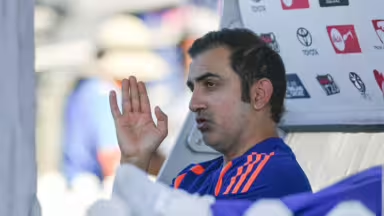
The Board of Control for Cricket in India (BCCI), the world’s richest cricket board, isn’t showing any live coverage of their premier domestic tournament, the Duleep Trophy. That was the only problem before the tournament commenced on August 28 at the Centre of Excellence (CoE) in Bengaluru.
Four days later, another, possibly larger, issue has emerged: the pitches. In the second quarterfinal between the Central and North East Zone, 1248 runs were scored in four days—a predictable outcome, as Central are much stronger. So maybe one can overlook it.
Batters shine, bowlers struggle
But the North and East Zones are more evenly matched. Both included, there are 5 players who have played for Team India. North has Arshdeep Singh and Harshit Rana, while East has Riyan Parag, Mohammed Shami, and Mukesh Kumar. As mentioned above, there isn’t any televised coverage. The only way to ascertain how the pitch played is by looking at the scorecard. The first quarterfinal has seen 1293 runs scored. Only 24 wickets have fallen. Does that sound fine?
The imbalance becomes clear considering that just 2 wickets fell on day three while 388 runs were scored in 90 overs at a 4.31 run rate. On Day 4, North Zone scored 270 in 56.4 overs for the loss of just 2 more wickets before the match was drawn. While Mukesh Kumar did not bowl in the second innings, the pitch offered little for bowlers. In Indian conditions, batting typically gets tougher as the match goes on due to the surface deteriorating.
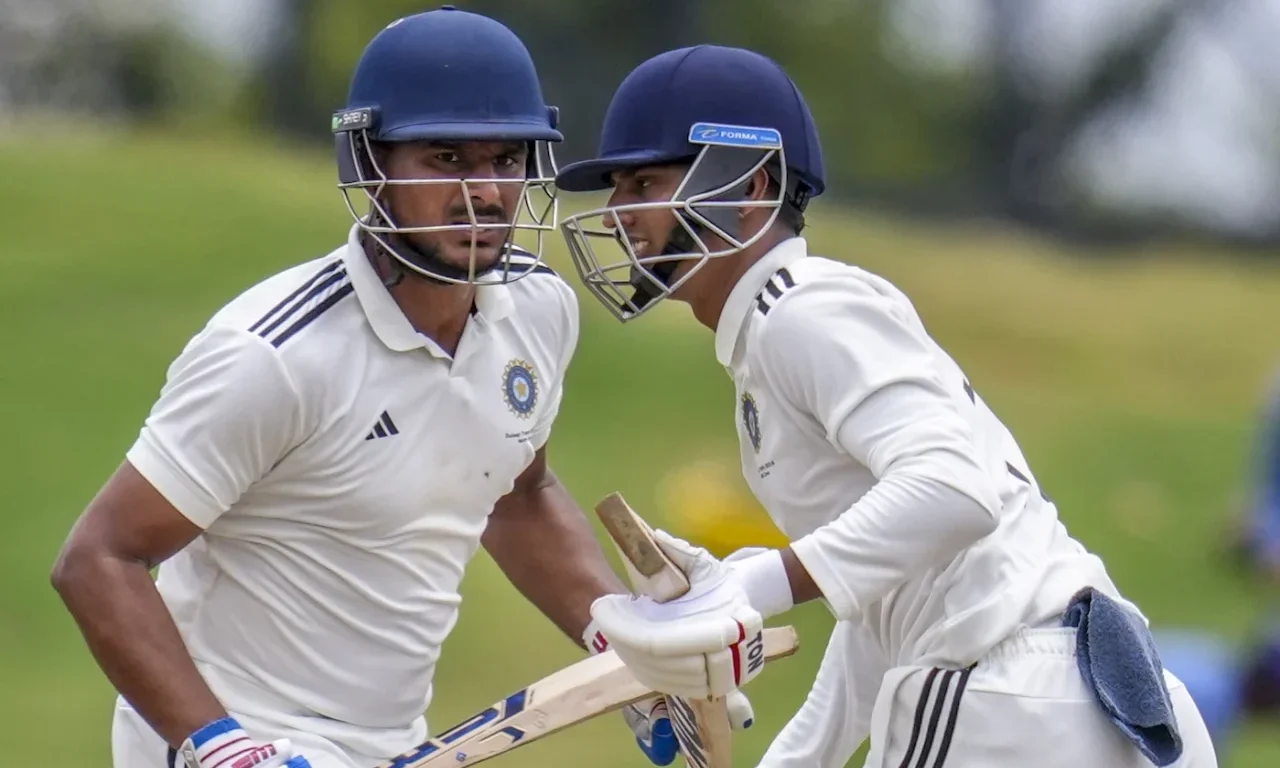
Even if it isn’t turn, the pitch cracks up. The ball keeps low, reverse comes into the game, and that’s how pacers like Umesh Yadav found success at home. But none of that seems to have happened. First, we saw a 54-run stand between Shubham Khajuria and Ankit Kumar. This was followed by a 240-run partnership between Ankit and Yash Dhull.
After that, there was a 150-run stand between Ankil and Ayush Badoni. Then a 157-run partnership between Badoni and Nishant Sindhu. And lastly, a 57-run stand between Badoni and Kanhaiya Wadhawan before North Zone declared at 658/4. The lowest partnership was of 54. Three of them are over 150. Batter’s paradise if there was one.

Will home Tests have the same pitches?
Surely this can’t be the best surface to prepare. Yes, you want to play on all sorts of pitches, but a surface like this doesn’t help anyone. In the last 7-8 years, pitches have gotten extremely tough all over the world. Barring England and Sri Lanka, you don’t even score 300 runs in the first innings that often.
Even when India plays, turners are prepared. Some aid spinners so much that sometimes even India is at a disadvantage. So, the question comes, if these aren’t the type of pitches that we’ll roll out against the West Indies or South Africa, what’s the purpose of preparing them at all?
Arshdeep, Harshit, Parag, Shami, Mukesh, Rajat Patidar, Kuldeep Yadav, and Khaleel Ahmed all played in these two matches. Some of them have a great chance of playing in India’s home Test matches as well. By seeing them play on such tracks, which won’t resemble the actual pitches for Tests, how can the selectors gauge who is worth considering?
Who wins?
These tracks will surely help batters score big and give them confidence, but what will happen to them if the surfaces start seaming or spinning from the get-go? You can make the case that bowlers will be forced to work on their line and length by bowling on such surfaces, but won’t they be tiring themselves out unnecessarily? This will be a case for fast bowlers more than spinners, but the point stands.
It shouldn’t be either a bowling or batting-friendly surface, but balanced pitches are where batters and bowlers are in the game most times. One can only hope that the surfaces will be better for the Duleep Trophy semifinals when other big weights also arrive.
 Cricket
India squad for Sri Lanka Tests to be picked this week: Bumrah, Jadeja to return, Washington Sundar doubtful
Cricket
India squad for Sri Lanka Tests to be picked this week: Bumrah, Jadeja to return, Washington Sundar doubtful